About the Event 2026 Economic and Infrastructure Summit: Strategies for Closing the Socioeconomic, Housing & Infrastructure Gaps in First Nations
The Assembly of First Nations (AFN) will host the 2026 Economic and Infrastructure Summit: Strategies for Closing the Socioeconomic, Housing & Infrastructure Gaps in First Nations from March 2 – 3, 2026. The forum will be held at Le Westin Montréal located at 270, Saint-Antoine Ouest, in Montreal, Quebec, the territory of the Mohawks of Kahnawà:ke.
The Summit is being held at a time when First Nations are poised to capitalize on transformational investments in infrastructure, resource development, and national defense. The AFN 2026 Economic and Infrastructure Summit will bring together Chiefs, business and finance leaders, and thought leaders to catalyze collective efforts to build capacity and advance First Nations self-determined approaches to economic development, infrastructure planning, delivery, finance and regulatory oversight, and identify new ways to continue closing the socioeconomic and infrastructure gaps between First Nations and the rest of Canada.
Register NowThis summit will include information and dialogue sessions on a range of topics that are key for First Nations to build awareness and capacity to engage on an informed basis in new economic opportunities.
The Summit will be held in hybrid format, open to 400 in-person participants and with many more spots for virtual participation. Registration will open soon, please keep watching this page for more information!
Who Should Attend?
- First Nations leadership
- First Nations housing managers and economic development officers
- First Nations economic, housing and infrastructure advocates and technicians
How to Attend Find out how to register, how to get there, and where to stay.
Registration
| Chief | $200.00 (in-person) $50.00 (virtual) |
| First Nations Delegate | $300.00 (in-person) $50.00 (virtual) |
| Corporate / Government Official Delegate | $600.00 (in-person) $50.00 (virtual) |
| Student (with a valid student card ) | Complimentary (in-person) (virtual) |
| Knowledge Keeper / Elder | Complimentary (in-person) (virtual) |
Registration fees are non-refundable after February 16, 2026. An administration fee of $50 will apply to cancellations.
Accommodation
Le Westin Montreal, 270 Rue Saint-Antoine O, Montréal, QC H2Y 0A3
- Rate: $299 per night
- Book online at: Book your group rate for AFN’s National Economic and Infrastructure Summit
- Book by phone: 1-833-320-6132
Last Day to Book : Sunday, February 01, 2026
Sponsorship
Background on Closing the Infrastructure Gap (CTIG) in First Nations
For decades First Nations have called on Canada to address the chronic underinvestment and neglect that have caused, and now sustain, the staggering socioeconomic and infrastructure gaps between First Nations and the rest of Canada. Continued long-term boil water advisories, crumbling schools, overreliance on winter ice roads, and crises of overcrowded and inadequate housing are a few examples among many.
Through persistent research and advocacy by the AFN and First Nations rights-holders, the Minister of Indigenous Services (ISC) was mandated in 2019 to:
Supported by the Minister of Infrastructure and Communities, work to co-develop and invest in distinctions-based community infrastructure plans, and move forward with addressing critical needs including housing, all-weather roads, high-speed internet, health facilities, treatment centres and schools in First Nations, Inuit and Métis communities by 2030. These plans should also include new investments to support the operation and maintenance of this infrastructure.
In recent years the AFN has partnered with industry-leading engineering and consulting firms, ISC, and the Conference Board of Canada to publish a total of four reports that, combined, provide a monumental body of evidence assessing the scope of the infrastructure gap across ten asset categories, nationally and per region, and detailing the costs and benefits of investing to close the infrastructure gap (CTIG) fully in all First Nations.
Research and Costing
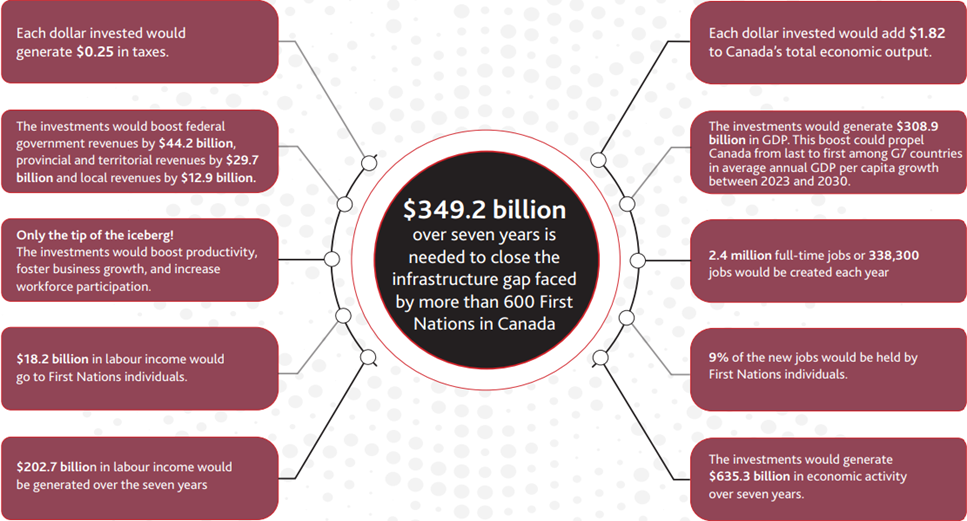
The first report, Closing the Infrastructure Gap by 2030: A Collaborative and Comprehensive Cost Estimate Identifying the Infrastructure Investment Needs of First Nations in Canada, is a national cost estimate that identifies $349.1 billion in capital and operations funding are required to close the gap across all asset categories, including safe drinking water, roads and highway structures, ports and wharfs, internet and cellular connectivity, housing repairs and new unit construction, community buildings, climate adaption, power supplies and more. The evidence base includes community-specific data on assets and immediate needs provided directly to the AFN and ISC through surveys administered to more than 400 First Nations. This represents an unrivaled success in detailed, comprehensive, First Nations-specific data collection.
“Closing the Infrastructure Gap by 2030: Prioritization and Implementation Plan”
The second report, Closing the Infrastructure Gap by 2030: Prioritization and Implementation Plan, includes sections on procurement and financing options, implementation schedules by region, cashflow forecasts, plans for prioritizing all season access roads, and climate risk mapping.
“Benefits for All Canadians (Part 1): Economic Impact of Closing the Infrastructure Gap”
The third report, Benefits for All Canadians (Part 1): Economic Impact of Closing the Infrastructure Gap, details the economic benefits associated with investing the full $349.1 billion required to close the infrastructure gap. These include generating $308.9 billion in GDP and propelling Canada from last to first among G7 nation in per capita GDP growth; creating 338,300 full-time jobs per year; and boosting federal, provincial, territorial and municipal revenues by a combined total of $86.8 billion.
The fourth report, Benefits for All Canadians (Part 2): Long-term Socio-economic Impacts of Closing the Infrastructure Gap, is based on a literature review and case studies, detailing the myriad downstream impacts that include tourism and industry development; improved community safety and accessibility; bolstering Canadian autonomy, resilience, and the individual and collective security of Canadians and First Nations; the preservation and application of traditional knowledge in climate adaptation and land use planning; resilience in emergencies; community empowerment and sustainable capacity building through the management of infrastructure projects; and improved health, wellness and educational outcomes.
The findings are clear and compelling; investing to CTIG will transform the Canadian economy. A focus on development projects that truly benefit and matter to First Nations means a higher likelihood of swift and successful execution, and avoids the risk of incurring more long-term, costly legal challenges that arise wherever Canada fails to honour its commitments and obligations to respect First Nations’ rights and interest.