Our Work We work with caregivers, policymakers and communities in support of First Nations holistic health.
Indigenous Peoples are disproportionately affected by disability, addictions, and mental health issues. Combined with the impacts of the pandemic, First Nations are faced with health challenges at a higher rate than other Canadian communities. The AFN Health Sector works to advocate for equitable, self-determined health care, and to promote holistic, culturally-based approaches to supporting First Nations wellness.
Indigenous Peoples are affected by disability 20‑50% more than non-Indigenous people.
According to Statistics Canada, roughly one in three First Nations and Métis people living off-reserve have a disability.
First Nations people are more likely to be diagnosed with chronic conditions.
56% of First Nations people report being diagnosed with one or more chronic conditions, compared with 48% of other Canadians.
Indigenous people are disproportionately affected by mental health challenges.
For example, suicide rates among First Nations people is estimated at five to six times higher than non-Indigenous populations.
First Nations seniors are at higher risk of social isolation than other seniors.
Among Indigenous seniors in cities, 23% are found to have low income compared with 13% of non-Indigenous seniors.
Overview Key updates, reports, and events advocating for First Nations health and wellness
Download up-to-date reports and reference materials related to First Nations Health and Wellness in Canada:
|
|
AFN Shadow Report to the UN – Accessibility –Learn about the AFN’s advocacy work to advance the rights of First Nations persons with disabilities (FNPWD). The Shadow Report to the United Nations Convention on the Rights of Persons with Disabilities (CRPD) identifies four key barriers to Canada’s compliance with the CRPD and provides recommendations to hold Canada accountable. |
|
|
7GCOC Report – Seven Generations Continuum of Care –The Seven Generations Continuum of Care (7GCOC) report outlines a strengths-based framework to transform First Nations healthcare. It emphasizes culturally safe, community-led systems rooted in First Nations worldviews, long-term planning, and wholistic well-being across generations. The framework supports First Nations in exercising self-determination in the design and delivery of healthcare. |
|
|
First Nations Health Priorities to Reducing Problematic Opioid Use: A First Nations Specific Opioid Strategy |
|
|
First Nations Policy Recommendations for the Development of a Wholistic Long-term and Continuing Care Framework The Reform of the First Nations and Inuit Home and Community Care and Assisted Living Programs |
|
|
Summary Report on the Assembly of First Nations (AFN) Non-Insured Health Benefits (NIHB) National Dialogue Session |
|
|
The Indian Residential Schools Resolution Health Support Program Continuation Report |
|
|
Honouring Our Strengths: A Renewed Framework to Address Substance Use Issues Among First Nations People in Canada |
|
|
Coming Out of Hibernation: A First Nations Health Human Resource Strategy |
|
|
First Nations Mental Wellness Continuum Framework |
|
|
A Distinct First Nations Accessibility Law Discussion Guide for First Nations |
|
|
Our Right to Health: First Nations’ Perspectives Across the Generations |
|
|
Sharing Honouring Practices in the Continuum of Care: First Nations Palliative and End-of-Life Care National Roundtable |
|
|
Seven Generations Continuum of Care |
|
|
The Indian Residential Schools Resolution Health Support Program: Strategic Advocacy Roadmap |
|
|
National Wellness Gathering for Indian Residential School Survivors and Indian Residential Schools Resolution Health Support Program Workforce 2024: Event Report |
|
|
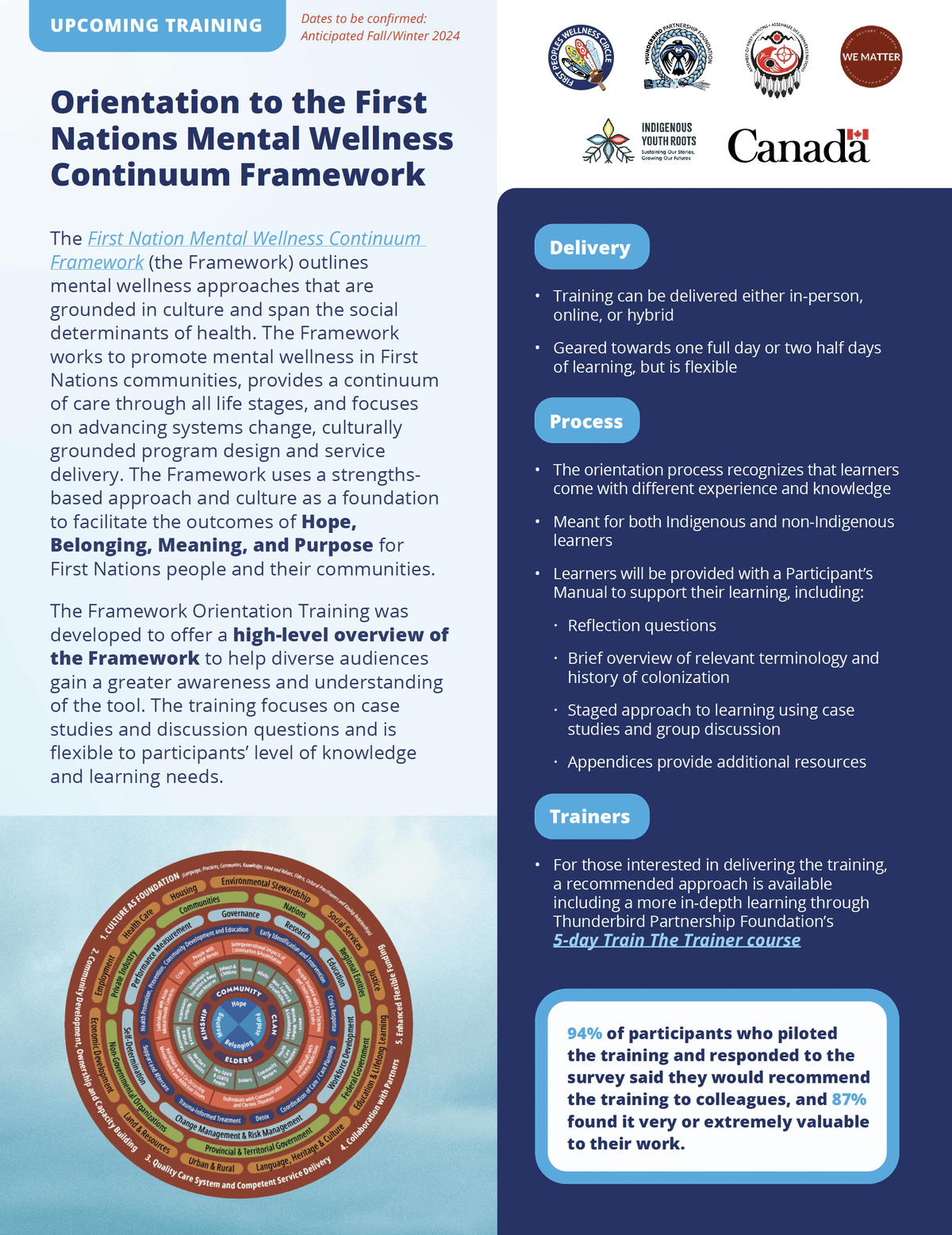
Orientation to the First Nations Mental Wellness Continuum Framework |
Initiatives & Priorities The policy areas, initiatives and committees driving change in First Nations health and wellness.
Non-Insured Health Benefits (NIHB)
The AFN is dedicated to advancing access to health are through the Non-Insured Health Benefits (NIHB) program and continues to advocate for expanded coverage, the elimination of discriminatory policies, and the upholding of the Crown’s Treaty obligations and First Nations’ Inherent right to health. The NIHB program is critical for many First Nations, providing coverage for essential medicines, dental and vision care, medical travel, and other vital services not insured through provincial and territorial health systems.
NIHB-focused gatherings hosted by the AFN bring together First Nations leaders, service providers, and community members to ensure federal policies reflect First Nations priorities and to create spaces for meaningful, solution-driven dialogue. Resolutions passed by the First Nations-in-Assembly continue to shape this work, ensuring that advocacy is grounded in long-standing commitments and a clear vision for health equity.
The AFN remains united in working alongside First Nations leaders, communities, and partners to advance a healthcare system grounded in cultural safety, dignity, and the affirmation of First Nations rights.
First Nations Accessibility Legislation
As mandated by First Nations-in-Assembly through Resolution #71/2024, Rejecting the Accessible Canada Act and Advancing Distinct First Nations Accessibility Legislation, the AFN is advocating for the creation of First Nations-led legislation that reflects First Nations values and worldview.
Over the coming months, the AFN is hosting four virtual regional dialogue sessions across Canada, in the Eastern, Central, Western, and Northern regions, to gather input on the development of a culturally sensitive Distinct First Nations Accessibility Legislation (DFNAL) framework.
The development of DFNAL is rooted in First Nations wisdom teachings and aims to revitalize traditional laws as a moral compass, guided by ancestral knowledge and tools. This culturally informed framework is being developed by First Nations, for First Nations. These sessions will invite the voices of First Nations leadership, persons with disabilities, Knowledge Keepers, parents, support professionals, caregivers, and others. Stay tuned for more information about the dialogue sessions.
Mental Wellness
Mental health and substance use remain key priorities, as First Nations continue to experience disproportionately high rates of mental health challenges, suicide, and addictions. The AFN applies culturally grounded frameworks, such as the First Nations Mental Wellness Continuum Framework and Honouring Our Strengths, to promote wellness through hope, belonging, meaning, and purpose.
The AFN continues to advocate for permanent, sustainable funding for the Indian Residential Schools Resolution Health Support Program (IRS RHSP), which supports Survivors, their families, and those affected by the Sixties Scoop, Day Schools, and child welfare.
Guidance and technical expertise come from key partners including the Thunderbird Partnership Foundation, First Peoples Wellness Circle, and the AFN Mental Wellness Committee, which informs advocacy at national, regional, and community levels.
Documents The latest resources on this topic.
View All 62 Documentsarrow_forwardThe Assembly of First Nations is committed to making all our digital sites and products accessible for people living with disabilities. We are continually improving the user experience for everyone while applying relevant accessibility standards: we strive to meet or exceed the W3C’s WCAG 2.1 Level AA for all our digital offerings.
Latest News
View AllAssembly of First Nations Calls for Equitable Health Care and Dedicated Council of the Federation Meeting on Indigenous Priorities
(July 15, 2024 – Kjipuktuk (Halifax), Nova Scotia) –Today, the Assembly of First Nations (AFN) participated in the Council of the Federation (COF) Summer Meeting, held from July 15-17, 2024, in Kjipuktuk (Halifax), Nova Scotia, alongside Premiers from provinces and…
Sign up for our Newsletter
Get the latest updates from the AFN in your inbox.
Contact Us
Reach out to the Assembly of First Nations
Assembly of First Nations
50 O’Connor Street, Suite 200
Ottawa, Ontario K1P 6L2
Tel: +1 (613) 241-6789
Toll-free: +1 (866) 869-6789
Fax: +1 (613) 241-5808